Abstract
Post-harvest management is a critical component of horticultural production that focuses on preserving the quality, safety, and marketability of fruits and vegetables after harvest. Globally, a significant proportion of fresh produce is lost due to improper harvesting, handling, transportation, storage, packaging, and marketing practices. These post-harvest losses reduce farmers' income, increase food waste, and threaten food and nutritional security. Effective post-harvest management practices, including proper harvesting techniques, pre-cooling, grading, sorting, packaging, cold chain management, controlled atmosphere storage, modified atmosphere packaging, waxing, edible coatings, and hygienic handling, play a vital role in extending shelf life and maintaining product quality. Modern technologies such as refrigerated transport, smart packaging, Internet of Things (IoT)-based storage monitoring, Artificial Intelligence (AI), Geographic Information Systems (GIS), blockchain-based traceability, and sensor technologies have significantly improved post-harvest handling and supply chain efficiency. These innovations reduce physiological deterioration, microbial spoilage, moisture loss, mechanical damage, and quality degradation while preserving nutritional value and consumer acceptability. Improved post-harvest management enhances market opportunities, export potential, and profitability by delivering safe, high-quality produce to consumers. However, inadequate infrastructure, limited cold storage facilities, poor transportation systems, high investment costs, and insufficient technical knowledge continue to constrain efficient post-harvest management in many developing countries. This paper examines major post-harvest management practices, evaluates their influence on shelf life and quality, discusses their role in reducing post-harvest losses, and explores emerging technologies and future prospects for sustainable horticultural supply chains..
- Post-Harvest Management
- Shelf Life
- Fruits and Vegetables
- Cold Chain
- Controlled Atmosphere Storage
- Modified Atmosphere Packaging
- Food Quality
- Cold Storage
- Supply Chain Management
- Sustainable Horticulture
Introduction#
Fruits and vegetables are among the most perishable agricultural commodities because of their high moisture content, active metabolism, and susceptibility to physical damage, microbial infection, and physiological deterioration after harvest. They are essential sources of vitamins, minerals, dietary fiber, antioxidants, and numerous bioactive compounds that contribute significantly to human health and nutrition. However, a substantial proportion of horticultural produce is lost between harvest and consumption due to inadequate post-harvest handling, inefficient storage, poor transportation, and improper marketing systems. Reducing these losses has become a global priority for improving food security, increasing farmer income, and promoting sustainable agricultural development. Post-harvest management refers to the scientific handling, processing, storage, packaging, transportation, and marketing of agricultural produce after harvesting to maintain quality and minimize quantitative and qualitative losses. The primary objective is to preserve freshness, nutritional value, appearance, texture, flavor, and safety until the produce reaches consumers. Effective post-harvest management begins immediately after harvesting and continues throughout the supply chain, requiring careful coordination among farmers, traders, processors, transporters, wholesalers, retailers, and consumers. Fresh fruits and vegetables continue to respire after harvest, consuming stored carbohydrates and releasing heat, carbon dioxide, and water vapor. High respiration rates accelerate ripening, senescence, moisture loss, and deterioration. Ethylene production further stimulates ripening in climacteric fruits such as mango, banana, tomato, papaya, and apple. Environmental factors including temperature, humidity, oxygen concentration, carbon dioxide levels, and mechanical injury greatly influence post-harvest quality and shelf life. Therefore, proper environmental control is essential for maintaining product freshness. Several post-harvest management practices have been developed to reduce deterioration and extend storage life. Careful harvesting minimizes bruising and mechanical injury, while pre-cooling rapidly removes field heat to slow respiration and microbial growth. Sorting and grading improve market quality by separating damaged or diseased produce. Appropriate packaging materials protect products during handling and transportation while maintaining favorable moisture conditions. Cold storage, refrigerated transportation, controlled atmosphere (CA) storage, modified atmosphere packaging (MAP), edible coatings, waxing, and hygienic handling further reduce quality losses and prolong shelf life. Technological advancements have revolutionized post-harvest management in recent years. Internet of Things (IoT)-based sensors continuously monitor storage temperature, humidity, and gas composition, allowing real-time environmental control. Artificial Intelligence (AI), machine learning, and computer vision systems facilitate automated grading, quality assessment, disease detection, and shelf-life prediction. Geographic Information Systems (GIS), blockchain technology, and digital traceability systems improve supply chain transparency, inventory management, and food safety. Smart packaging equipped with freshness indicators and biosensors enables continuous monitoring of product quality during transportation and storage.
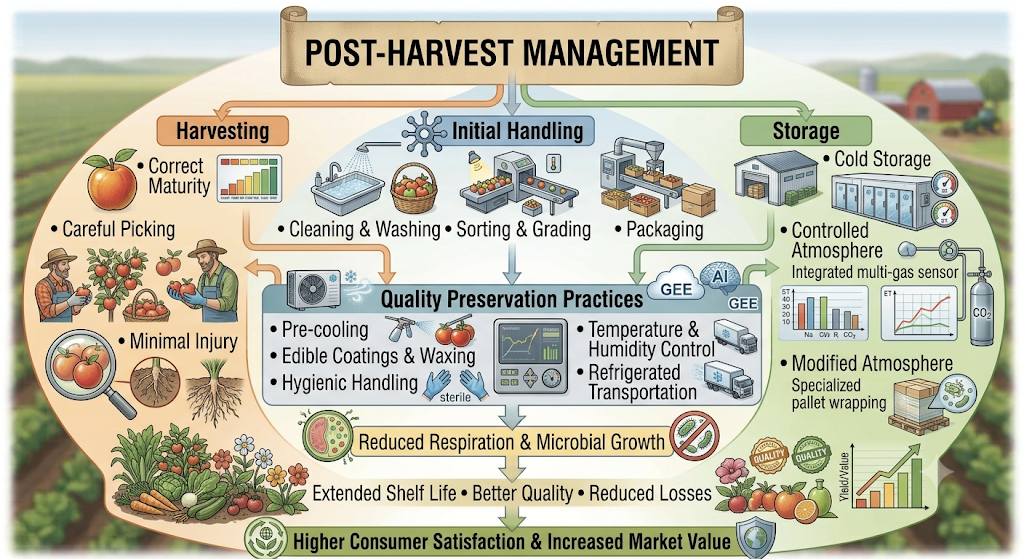
Figure . Principles and Components of Post-Harvest Management
Efficient post-harvest management also contributes significantly to environmental sustainability. Reducing food losses conserves water, energy, fertilizers, labor, and other agricultural inputs while lowering greenhouse gas emissions associated with wasted food production. Improved storage and transportation systems reduce economic losses and strengthen the competitiveness of horticultural products in domestic and international markets.
Despite considerable technological progress, post-harvest losses remain high in many developing countries due to inadequate cold chain infrastructure, limited storage facilities, poor transportation networks, insufficient technical knowledge, fragmented supply chains, and financial constraints. Government support, investment in infrastructure, research, farmer training, and adoption of modern technologies are therefore essential for improving post-harvest management systems.
This paper examines the major post-harvest management practices used in fruits and vegetables, evaluates their impact on shelf life and quality, discusses their contribution to reducing post-harvest losses and enhancing market value, and explores emerging technologies and future prospects for sustainable horticultural supply chain management.
Principles and Components of Post-Harvest Management in Fruits and Vegetables#
Post-harvest management comprises a series of scientific and technical operations performed after harvesting to preserve the quality, nutritional value, safety, and marketability of fruits and vegetables until they reach consumers. Since horticultural commodities remain biologically active after harvest, they continue to undergo physiological and biochemical changes such as respiration, transpiration, ethylene production, ripening, and senescence. Proper post-harvest management aims to slow these processes, minimize quantitative and qualitative losses, and maintain product freshness throughout the supply chain. One of the fundamental principles of post-harvest management is harvesting at the proper stage of maturity. Fruits and vegetables harvested too early often fail to develop optimum flavor, color, texture, and nutritional quality, whereas over-mature produce deteriorates rapidly during storage and transportation. Harvest maturity depends on crop type and intended market. Indicators such as fruit size, color development, firmness, soluble solids content, days after flowering, and physiological maturity are commonly used to determine the ideal harvesting stage. Proper harvesting techniques play a crucial role in reducing mechanical injury. Harvesting during the cooler hours of the day, using sharp and clean harvesting tools, and carefully handling produce minimize bruising, cuts, compression damage, and microbial contamination. Mechanical injuries increase respiration, moisture loss, and susceptibility to fungal and bacterial infections, thereby shortening shelf life. Immediately after harvest, pre-cooling is considered one of the most important post-harvest operations. Freshly harvested produce contains field heat, which accelerates respiration and microbial growth. Rapid removal of this heat through methods such as forced-air cooling, hydro-cooling, vacuum cooling, room cooling, or ice cooling significantly slows physiological deterioration and extends storage life. Pre-cooling also improves the efficiency of subsequent cold storage operations. Cleaning, washing, sorting, and grading are essential components of post-harvest handling. Washing removes soil, pesticide residues, dust, and microorganisms from the produce surface, improving hygiene and appearance. Sorting eliminates damaged, diseased, insect-infested, and overripe produce, preventing the spread of spoilage during storage. Grading classifies fruits and vegetables according to size, shape, color, weight, and quality, ensuring uniformity and increasing market value. Appropriate packaging protects produce from mechanical damage, moisture loss, and microbial contamination during handling and transportation.
Modern packaging materials include corrugated fiberboard boxes, plastic crates, ventilated cartons, biodegradable packaging, and modified atmosphere packaging (MAP). Packaging not only preserves quality but also facilitates efficient transportation, storage, and retail display. Cold storage and cold chain management represent the backbone of modern post-harvest systems. Maintaining low temperatures slows respiration, ethylene production, enzymatic activity, moisture loss, and microbial growth. Different fruits and vegetables require specific storage temperatures and relative humidity levels to prevent chilling injury or excessive dehydration. Cold chain management ensures that these conditions are maintained continuously from harvest to consumer through refrigerated storage, transport, wholesale markets, and retail outlets. Another important component is Controlled Atmosphere (CA) Storage and Modified Atmosphere Packaging (MAP). CA storage regulates oxygen, carbon dioxide, and nitrogen concentrations within storage chambers to reduce respiration and delay ripening. MAP modifies the gaseous environment inside sealed packages, extending shelf life while preserving color, texture, flavor, and nutritional quality. These technologies are widely used for apples, pears, berries, tomatoes, leafy vegetables, and other high-value horticultural crops. Additional post-harvest treatments such as waxing, edible coatings, fungicide application, irradiation, and ozone treatment further improve shelf life by reducing moisture loss, delaying ripening, controlling pathogens, and maintaining appearance. Natural edible coatings prepared from chitosan, aloe vera, starch, pectin, and cellulose have gained increasing importance because they are biodegradable, safe, and environmentally friendly.
Overall, effective post-harvest management integrates scientific harvesting, careful handling, rapid cooling, proper storage, advanced packaging, and modern preservation technologies to reduce losses, maintain nutritional quality, improve food safety, and increase the economic value of fruits and vegetables throughout the supply chain.
Effect of Post-Harvest Management Practices on Shelf Life and Quality of Fruits and Vegetables#
Post-harvest management practices have a direct influence on the shelf life, nutritional quality, appearance, safety, and market value of fruits and vegetables. Since horticultural produce remains physiologically active after harvest, improper handling accelerates respiration, transpiration, ripening, senescence, microbial spoilage, and mechanical damage, leading to significant post-harvest losses. Scientific post-harvest interventions effectively slow these deterioration processes, allowing produce to retain its freshness and quality for longer periods while improving consumer acceptance and profitability.
One of the most important effects of post-harvest management is the extension of shelf life. Respiration is a natural metabolic process through which harvested produce consumes stored carbohydrates and releases carbon dioxide, water, and heat. High respiration rates accelerate ripening and senescence, reducing storage life. Practices such as rapid pre-cooling, refrigeration, controlled atmosphere storage, and modified atmosphere packaging lower respiration rates by reducing temperature and regulating oxygen and carbon dioxide concentrations. Consequently, fruits and vegetables remain fresh for extended periods without significant quality deterioration.
Post-harvest management also helps maintain physical quality attributes such as color, firmness, texture, shape, and freshness. Proper harvesting techniques minimize bruising and mechanical injury, while suitable packaging materials protect produce during transportation and storage. Cold storage slows cell wall degradation, preserving firmness and reducing wilting in leafy vegetables. Controlled humidity prevents excessive moisture loss, thereby maintaining weight, appearance, and marketable quality. Uniform grading and sorting further improve the visual appeal of produce and facilitate better marketing.
Another significant benefit is the preservation of nutritional quality. Fruits and vegetables are rich sources of vitamins, minerals, antioxidants, phenolic compounds, carotenoids, flavonoids, and dietary fiber. These nutrients gradually decline after harvest due to oxidation, enzymatic activity, and prolonged storage. Appropriate temperature management, edible coatings, controlled atmosphere storage, and modified atmosphere packaging reduce metabolic activity and nutrient degradation. As a result, products retain higher levels of vitamin C, beta-carotene, antioxidants, sugars, and other essential nutrients during storage.
Effective post-harvest management substantially reduces microbial spoilage and post-harvest diseases. Mechanical injuries often create entry points for fungal and bacterial pathogens responsible for decay. Hygienic harvesting, cleaning, washing with sanitizing solutions, fungicidal treatments, irradiation, ozone application, ultraviolet (UV-C) treatment, and edible antimicrobial coatings effectively suppress microbial growth. Lower storage temperatures further inhibit the multiplication of spoilage microorganisms, thereby improving food safety and reducing economic losses.
Modern preservation techniques such as controlled atmosphere (CA) storage, modified atmosphere packaging (MAP), and edible coatings have significantly enhanced quality maintenance. Controlled atmosphere storage regulates oxygen and carbon dioxide levels to delay ripening, reduce ethylene production, and slow physiological deterioration. Modified atmosphere packaging creates a favorable gaseous environment within sealed packages that minimizes respiration and moisture loss. Edible coatings prepared from chitosan, aloe vera gel, starch, cellulose, alginate, and pectin act as semi-permeable barriers that reduce water loss, delay ripening, improve gloss, and extend storage life without affecting consumer safety.
Post-harvest management also contributes to improved consumer acceptability and market value. Fruits and vegetables with better color, size, firmness, aroma, flavor, and nutritional quality command higher prices in domestic and export markets. Standardized grading, attractive packaging, and proper labeling increase consumer confidence and facilitate efficient marketing. Extended shelf life also reduces transportation constraints, enabling producers to access distant markets and minimize financial losses caused by spoilage.
Technological advancements have further improved post-harvest quality management through Internet of Things (IoT) sensors, Artificial Intelligence (AI), machine learning, computer vision, and blockchain-based traceability systems. These technologies monitor storage conditions in real time, predict shelf life, detect quality defects, automate grading, and improve supply chain transparency. Such precision management ensures consistent product quality while reducing food waste and operational costs.
Overall, scientific post-harvest management practices significantly enhance the shelf life, nutritional value, physical appearance, safety, and marketability of fruits and vegetables. Their adoption is essential for reducing post-harvest losses, improving food security, increasing farmers' income, and supporting sustainable horticultural supply chains.
Role of Post-Harvest Technologies in Reducing Losses and Improving Market Value#
Post-harvest technologies play a pivotal role in minimizing quantitative and qualitative losses of fruits and vegetables while enhancing their commercial value throughout the supply chain. Globally, post-harvest losses of horticultural produce are estimated to range between 20% and 40%, depending on the crop, climatic conditions, infrastructure, and management practices. These losses occur due to physiological deterioration, microbial spoilage, mechanical damage, improper handling, inadequate storage, and inefficient transportation systems. The adoption of modern post-harvest technologies significantly reduces these losses by maintaining freshness, nutritional quality, and consumer acceptability.
One of the most effective technologies is the cold chain system, which includes pre-cooling, refrigerated storage, refrigerated transportation, and temperature-controlled retail facilities. Maintaining optimum storage temperatures slows respiration, transpiration, ethylene production, and microbial growth, thereby extending shelf life and preserving quality. Cold chain management is particularly beneficial for highly perishable commodities such as strawberries, grapes, tomatoes, leafy vegetables, broccoli, cauliflower, mangoes, and bananas. Continuous temperature management throughout the supply chain minimizes spoilage and ensures that produce reaches consumers in excellent condition.
Controlled Atmosphere (CA) Storage and Modified Atmosphere Packaging (MAP) have further improved long-term storage of horticultural commodities. Controlled atmosphere storage regulates oxygen, carbon dioxide, and nitrogen concentrations within storage chambers to slow metabolic activity and delay ripening. Modified atmosphere packaging modifies the gaseous composition inside packages, reducing respiration and moisture loss while preserving color, texture, flavor, and nutritional quality. These technologies have become widely adopted for apples, pears, berries, citrus fruits, tomatoes, and leafy vegetables.
Modern packaging technologies provide both physical protection and quality preservation. Ventilated cartons, corrugated fiberboard boxes, plastic crates, biodegradable packaging materials, and cushioning materials minimize mechanical damage during transportation. Smart packaging equipped with freshness indicators, biosensors, temperature sensors, and radio-frequency identification (RFID) tags enables continuous monitoring of product quality and storage conditions. Such innovations improve inventory management, reduce wastage, and strengthen consumer confidence.
Edible coatings and surface treatments represent environmentally friendly technologies for preserving horticultural produce. Natural coatings prepared from chitosan, aloe vera, starch, pectin, alginate, cellulose, and beeswax form protective barriers that reduce moisture loss, slow respiration, inhibit microbial growth, and delay ripening. Additional treatments such as ozone fumigation, ultraviolet (UV-C) irradiation, hot water treatment, and food-grade sanitizers effectively control post-harvest pathogens while maintaining product safety.
Digital technologies have significantly transformed post-harvest management. Internet of Things (IoT) sensors continuously monitor storage temperature, relative humidity, gas composition, and ethylene concentration. Artificial Intelligence (AI) and Machine Learning (ML) analyze these data to predict shelf life, detect quality defects, optimize storage conditions, and support inventory management. Computer vision systems automate grading, sorting, and defect detection, improving efficiency and consistency while reducing labor requirements.
Blockchain technology and digital traceability systems improve transparency throughout the horticultural supply chain. Each stage of production, storage, transportation, and marketing can be digitally recorded, enabling rapid identification of quality issues and enhancing consumer trust. Geographic Information Systems (GIS), Remote Sensing (RS), and cloud-based logistics platforms further optimize transportation routes and storage planning, reducing delays and minimizing spoilage.
The adoption of these technologies substantially increases the market value of horticultural produce. Fruits and vegetables with superior freshness, uniform grading, attractive packaging, extended shelf life, and lower microbial contamination command premium prices in domestic and international markets. Improved quality also facilitates compliance with export standards, food safety regulations, and consumer preferences for high-quality fresh produce.
Overall, post-harvest technologies are essential for reducing food losses, improving quality preservation, strengthening supply chain efficiency, enhancing market competitiveness, and promoting sustainable horticultural development.
Challenges, Emerging Technologies, and Future Prospects of Post-Harvest Management#
Although significant progress has been made in post-harvest management, numerous challenges continue to limit its effectiveness, particularly in developing countries. High post-harvest losses remain a major concern due to inadequate infrastructure, insufficient cold storage capacity, poor transportation networks, fragmented marketing systems, limited technical knowledge, and financial constraints. Addressing these challenges through technological innovation, infrastructure development, and policy support is essential for building efficient and sustainable horticultural supply chains.One of the most significant challenges is the lack of cold chain infrastructure. Many fruits and vegetables deteriorate rapidly because field heat is not removed immediately after harvest and storage temperatures cannot be maintained throughout transportation and marketing. Limited availability of refrigerated vehicles, cold storage facilities, and pack houses increases spoilage, especially in rural production areas. Investment in integrated cold chain systems is therefore essential for reducing losses and improving product quality. Another major challenge is mechanical damage during harvesting, handling, packaging, and transportation. Improper harvesting methods, rough handling, inadequate packaging materials, and poor road infrastructure often cause bruising, cuts, compression injuries, and physiological disorders that accelerate microbial spoilage. Improved harvesting equipment, standardized packaging systems, and better transportation facilities can significantly reduce these losses. Recent advances in digital agriculture have introduced innovative solutions for post-harvest management. Internet of Things (IoT) devices equipped with wireless sensors continuously monitor temperature, humidity, carbon dioxide, oxygen, and ethylene concentrations in storage facilities and transport vehicles. Real-time monitoring allows rapid corrective actions whenever storage conditions deviate from optimum levels, thereby reducing quality deterioration. Artificial Intelligence (AI) and Machine Learning (ML) are increasingly applied for automated quality grading, shelf-life prediction, disease detection, inventory optimization, and supply chain management. Computer vision systems accurately assess fruit size, color, maturity, defects, bruises, and surface diseases without damaging the produce. Predictive algorithms estimate remaining shelf life, enabling better marketing and reducing food waste. Smart packaging technologies represent another major innovation. Intelligent packaging materials equipped with freshness indicators, biosensors, temperature-sensitive labels, and RFID tags provide continuous information regarding product quality throughout the supply chain. Consumers, retailers, and distributors can monitor freshness in real time, reducing spoilage and improving food safety.
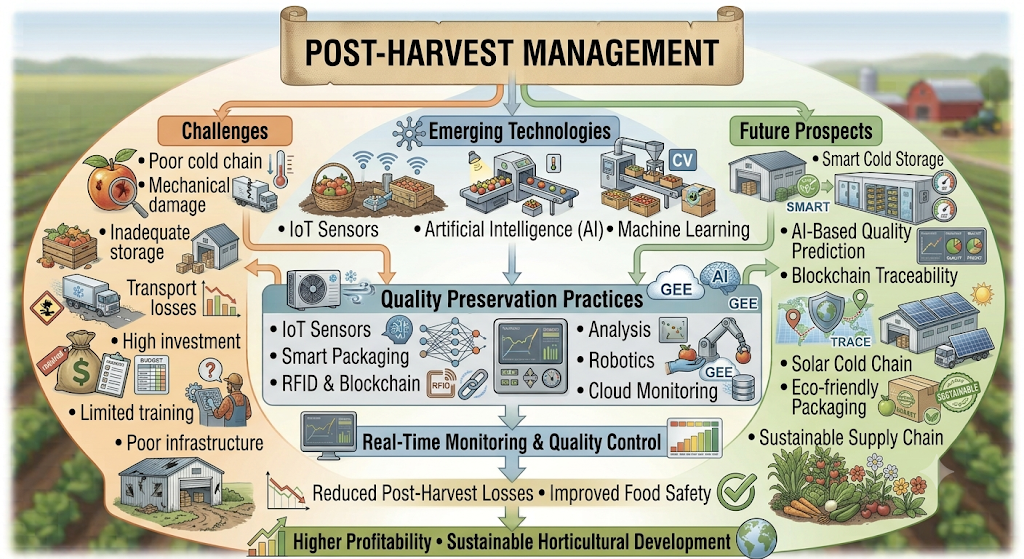
Figure. Challenges, Emerging Technologies, and Future Prospects of Post-Harvest Management
Blockchain technology is improving traceability and transparency in horticultural supply chains by securely recording every stage from farm to consumer. This technology strengthens food safety, facilitates rapid product recalls when necessary, prevents fraud, and increases consumer confidence in product authenticity. Integration of blockchain with IoT devices further enhances monitoring and quality assurance. Future post-harvest systems are expected to incorporate robotics, automation, drones, cloud computing, Geographic Information Systems (GIS), and Remote Sensing (RS) for intelligent logistics, automated warehouses, precision inventory management, and optimized transportation routes. Renewable energy-powered cold storage facilities using solar refrigeration are also gaining importance in remote agricultural regions where electricity supply is unreliable. Climate change presents new challenges for post-harvest management by increasing temperature fluctuations, transportation disruptions, and storage requirements. Therefore, climate-resilient storage technologies, energy-efficient refrigeration systems, biodegradable packaging materials, and environmentally friendly preservation methods will become increasingly important in sustainable horticultural supply chains.
Government support through infrastructure development, farmer training, financial incentives, research investment, quality standards, and extension services remains essential for improving post-harvest management. Public-private partnerships and digital agriculture initiatives can further accelerate technology adoption among smallholder farmers.
Overall, future post-harvest management will rely on integrating smart technologies, automation, sustainable packaging, precision logistics, and climate-resilient infrastructure to reduce food losses, improve product quality, enhance market competitiveness, and strengthen global food security.
Conclusion#
Post-harvest management is a fundamental component of modern horticulture that ensures the preservation of quality, safety, and nutritional value of fruits and vegetables after harvest. Since these commodities remain biologically active and highly perishable, improper handling during harvesting, storage, transportation, packaging, and marketing can result in substantial quantitative and qualitative losses. Effective post-harvest management practices therefore play a critical role in reducing food waste, improving marketability, increasing farmer income, and strengthening food and nutritional security. This study has demonstrated that scientific post-harvest practices—including proper harvesting, pre-cooling, sorting, grading, packaging, cold chain management, controlled atmosphere storage, modified atmosphere packaging, edible coatings, and hygienic handling—significantly enhance the shelf life and quality of fruits and vegetables. These interventions reduce respiration, transpiration, microbial spoilage, moisture loss, and mechanical damage while preserving color, texture, flavor, appearance, and nutritional composition. Consequently, consumers receive safer, fresher, and higher-quality produce, and producers benefit from reduced losses and improved profitability. Modern post-harvest technologies have further strengthened supply chain efficiency. Cold chain systems maintain optimal storage conditions from farm to market, while smart packaging, IoT sensors, AI-based quality assessment, computer vision, blockchain traceability, GIS, and automated logistics improve monitoring, grading, inventory management, and transportation. These innovations support data-driven decision-making, minimize spoilage, and enhance transparency across the horticultural supply chain. In addition to economic benefits, efficient post-harvest management contributes significantly to environmental sustainability. Reducing post-harvest losses conserves valuable natural resources such as water, land, fertilizers, labor, and energy that are invested in crop production. Lower food waste also decreases greenhouse gas emissions associated with decomposing organic matter and unnecessary agricultural production, thereby supporting climate-smart agriculture and sustainable development goals.
Despite considerable progress, several challenges continue to hinder effective post-harvest management, particularly in developing countries. Limited cold storage facilities, poor transportation infrastructure, inadequate packaging systems, insufficient technical expertise, and financial constraints often lead to high post-harvest losses. Addressing these issues requires coordinated efforts involving governments, research institutions, private industries, extension agencies, and farmers. Investment in modern infrastructure, capacity building, quality standards, and digital technologies will be essential for improving post-harvest systems. Looking ahead, the future of post-harvest management lies in integrating advanced technologies such as artificial intelligence, machine learning, Internet of Things, robotics, blockchain, renewable energy-powered cold storage, and biodegradable packaging. These innovations will enhance quality preservation, optimize logistics, strengthen food safety, and reduce environmental impacts. As global demand for fresh, nutritious, and high-quality horticultural products continues to increase, efficient post-harvest management will become even more important in ensuring sustainable food systems.
In conclusion, post-harvest management is not merely a set of storage and handling practices but a comprehensive scientific approach that connects agricultural production with consumer satisfaction. The adoption of modern post-harvest technologies, coupled with supportive policies, infrastructure development, and farmer education, will play a decisive role in reducing food losses, improving agricultural profitability, and ensuring sustainable horticultural development in the future.
Works Cited#
- Food and Agriculture Organization. (2022). The State of Food and Agriculture 2022: Leveraging Automation in Agriculture for Transforming Agrifood Systems. FAO.
- Food and Agriculture Organization. (2021). The State of Food and Agriculture: Making Agrifood Systems More Resilient to Shocks and Stresses. FAO.
- Kader, A. A. (2002). Postharvest Technology of Horticultural Crops (3rd ed.). University of California, Agriculture and Natural Resources.
- Wills, R. B. H., McGlasson, W. B., Graham, D., & Joyce, D. C. (2007). Postharvest: An Introduction to the Physiology and Handling of Fruit, Vegetables and Ornamentals (5th ed.). CABI.
- Yahia, E. M. (Ed.). (2019). Postharvest Technology of Perishable Horticultural Commodities. Woodhead Publishing.
- Thompson, J. F., Mitchell, F. G., Kasmire, R. F., & Crisosto, C. H. (2010). Commercial Cooling of Fruits, Vegetables, and Flowers. University of California.
- Kitinoja, L., & Kader, A. A. (2015). Measuring Postharvest Losses of Fresh Fruits and Vegetables in Developing Countries. The Postharvest Education Foundation.
- Saltveit, M. E. (2016). Respiratory Metabolism and Shelf-Life of Fresh Horticultural Crops. Postharvest Biology and Technology, 121, 1–8.
- Singh, Z., Singh, R. K., & Sane, V. A. (2014). Mango Postharvest Biology and Biotechnology. Critical Reviews in Plant Sciences, 33(3), 217–236.
- Kader, A. A., & Rolle, R. S. (2004). The Role of Post-Harvest Management in Assuring the Quality and Safety of Horticultural Produce. FAO.
- International Society for Horticultural Science. (2022). Acta Horticulturae: Postharvest Technology and Quality Management.
- ICAR-Indian Agricultural Research Institute. (2022). Post-Harvest Management of Fruits and Vegetables. ICAR-IARI.
- National Horticulture Board. (2023). Indian Horticulture Database. Government of India.
- Intergovernmental Panel on Climate Change. (2023). Climate Change 2023: Synthesis Report. IPCC.
- United Nations Environment Programme. (2021). Food Waste Index Report. UNEP.
- CABI. (2021). Crop Protection and Postharvest Management Compendium. CAB International.
- Environmental Systems Research Institute. (2023). ArcGIS Pro Documentation. ESRI.
- World Bank. (2023). Food Loss and Waste Reduction for Sustainable Food Systems. World Bank.
- United States Department of Agriculture. (2022). Agricultural Handbook: Commercial Storage of Fruits, Vegetables, and Florist and Nursery Stocks. USDA.
- Journal of Postharvest Technology. (2023). Recent Advances in Postharvest Technology and Cold Chain Management. Journal of Postharvest Technology.