Abstract
Protected cultivation has emerged as an advanced agricultural technology for improving vegetable production, quality, and resource-use efficiency under changing climatic conditions. It involves the cultivation of crops in controlled or partially controlled environments using structures such as greenhouses, polyhouses, shade nets, low tunnels, insect-proof net houses, and walk-in tunnels. These technologies enable growers to regulate environmental factors including temperature, humidity, light intensity, carbon dioxide concentration, and irrigation, thereby creating optimal conditions for plant growth throughout the year. Protected cultivation minimizes the adverse effects of extreme weather, pests, diseases, and abiotic stresses while increasing crop productivity and ensuring a consistent supply of high-quality vegetables. The adoption of modern irrigation systems, fertigation, hydroponics, precision nutrient management, and integrated pest management further enhances water-use efficiency, fertilizer-use efficiency, and crop health. Vegetables produced under protected structures generally exhibit higher yields, improved size, better color, enhanced nutritional quality, reduced pesticide residues, and longer shelf life compared to open-field cultivation. Recent advancements in Internet of Things (IoT), Artificial Intelligence (AI), Geographic Information Systems (GIS), Remote Sensing (RS), automation, robotics, and smart climate-control systems have transformed protected cultivation into an efficient precision farming approach. Despite its numerous benefits, challenges such as high initial investment, energy requirements, technical complexity, and limited farmer awareness continue to restrict widespread adoption. This paper examines the various protected cultivation technologies, evaluates their influence on vegetable production and quality, discusses their role in sustainable resource management, and explores emerging technologies and future prospects for climate-resilient vegetable production.
- Protected Cultivation
- Greenhouse
- Polyhouse
- Vegetable Production
- Crop Quality
- Precision Agriculture
- Resource-Use Efficiency
- Hydroponics
- Climate-Smart Agriculture
- Sustainable Horticulture
Introduction#
Vegetable crops are an essential component of global food and nutritional security because they provide vitamins, minerals, dietary fiber, antioxidants, and numerous health-promoting compounds. The increasing demand for fresh vegetables, combined with challenges such as climate change, shrinking cultivable land, water scarcity, pest infestations, and unpredictable weather conditions, has created a need for advanced production technologies that ensure higher productivity and consistent quality. Protected cultivation has emerged as one of the most effective approaches for addressing these challenges by creating favorable environmental conditions for crop growth while minimizing production risks.
Protected cultivation refers to the practice of growing crops under structures that partially or completely modify the natural environment. Common protected cultivation systems include naturally ventilated polyhouses, climate-controlled greenhouses, shade-net houses, insect-proof net houses, plastic tunnels, low tunnels, and walk-in tunnels. These structures allow growers to regulate temperature, humidity, light intensity, ventilation, carbon dioxide concentration, and irrigation according to crop requirements. By providing an optimum microclimate, protected cultivation enables year-round vegetable production, improves resource-use efficiency, and enhances crop quality.
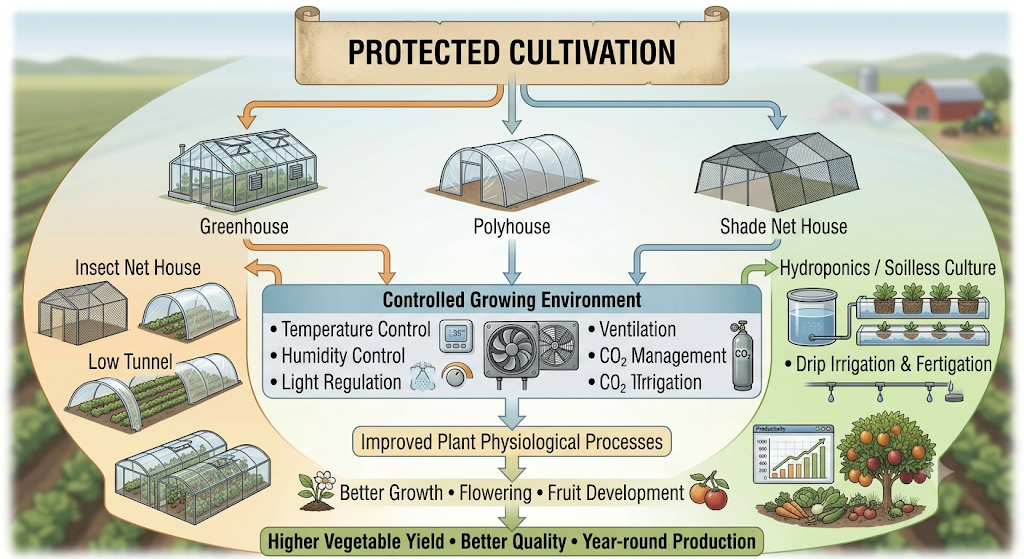
Figure. Protected Cultivation Technologies, Types, and Crop Production Mechanism
One of the major advantages of protected cultivation is its ability to protect crops from adverse environmental conditions such as excessive rainfall, frost, hailstorms, strong winds, heat waves, and drought. The controlled environment also reduces damage caused by insects, pathogens, and weeds, leading to lower pesticide use and healthier produce. Consequently, vegetables grown under protected structures often exhibit improved appearance, uniform size, enhanced nutritional value, and longer post-harvest shelf life, increasing their market value and consumer acceptance.
Modern protected cultivation systems are closely integrated with advanced technologies such as drip irrigation, fertigation, hydroponics, aeroponics, soilless cultivation, precision nutrient management, and Integrated Pest Management (IPM). These technologies optimize water and nutrient application while minimizing wastage and environmental pollution. Hydroponic and substrate-based cultivation systems further reduce dependence on soil and enable vegetable production even in areas with poor soil quality.
The rapid development of digital agriculture has significantly enhanced the efficiency of protected cultivation. Internet of Things (IoT)-based sensors continuously monitor environmental parameters including temperature, humidity, soil moisture, nutrient concentration, and light intensity. Artificial Intelligence (AI), machine learning, automation, robotics, Geographic Information Systems (GIS), Remote Sensing (RS), and drone technologies support data-driven decision-making, climate control, disease detection, irrigation scheduling, and precision nutrient management. These innovations improve productivity while reducing labor requirements and production costs.
Protected cultivation also contributes significantly to sustainable agriculture by improving water-use efficiency, fertilizer-use efficiency, land-use efficiency, and energy management. Drip irrigation and fertigation reduce water consumption while ensuring precise nutrient delivery. Controlled environments increase crop productivity per unit area, making protected cultivation especially suitable for regions with limited land availability and growing urban populations.
Despite its numerous advantages, protected cultivation faces several challenges including high installation costs, energy consumption, technical management requirements, pest outbreaks under enclosed conditions, and limited access to quality planting material. Smallholder farmers often encounter financial and technical barriers that restrict adoption. Government support, capacity building, affordable technologies, and continued research are therefore essential to expand protected cultivation practices.
This paper examines different protected cultivation technologies, evaluates their influence on vegetable growth, yield, and quality, discusses their contribution to sustainable resource management, and explores emerging technological innovations and future prospects for climate-resilient vegetable production.
Protected Cultivation Technologies, Types, and Crop Production Mechanisms#
Protected cultivation encompasses a range of technologies designed to create favorable environmental conditions for crop growth by modifying or controlling factors such as temperature, humidity, light intensity, ventilation, carbon dioxide concentration, and irrigation. These technologies protect vegetable crops from adverse weather conditions, pests, diseases, and environmental stresses while improving resource-use efficiency and crop productivity. The choice of protected cultivation structure depends on climatic conditions, crop requirements, available investment, and production objectives.
Among the various systems, greenhouses are the most advanced protected cultivation structures. Greenhouses are enclosed constructions covered with transparent materials such as glass or polycarbonate sheets that allow sunlight to enter while maintaining a controlled internal environment. Depending on the level of environmental regulation, greenhouses may be naturally ventilated or fully climate-controlled using automated heating, cooling, ventilation, misting, shading, and carbon dioxide enrichment systems. High-value vegetables such as tomato, cucumber, sweet pepper, lettuce, and leafy greens are commonly cultivated under greenhouse conditions due to their ability to produce superior yields and premium-quality produce throughout the year.
Polyhouses are widely adopted because they are relatively economical compared to glass greenhouses. Constructed using galvanized iron frames covered with ultraviolet (UV)-stabilized polyethylene sheets, polyhouses protect crops from excessive rainfall, wind, frost, and temperature fluctuations while allowing sufficient sunlight for photosynthesis. Naturally ventilated polyhouses are particularly suitable for tropical and subtropical regions where moderate environmental control is sufficient for vegetable production.
Another important protected cultivation technology is the shade-net house, which uses colored shade nets to regulate light intensity and reduce excessive heat during summer months. Shade nets decrease solar radiation, lower canopy temperature, and improve humidity, creating favorable growing conditions for leafy vegetables, nursery seedlings, and ornamental crops. Different shading percentages are selected depending on crop species and climatic conditions.
Insect-proof net houses provide physical protection against insect pests while allowing natural ventilation. Fine mesh nets prevent the entry of insects such as aphids, whiteflies, thrips, and leaf miners, thereby reducing virus transmission and minimizing pesticide use. These structures are particularly beneficial for producing healthy seedlings and high-quality vegetables under integrated pest management (IPM) programs.
Low tunnels and walk-in tunnels are simple and cost-effective structures covered with transparent plastic films. Low tunnels are commonly used during winter to protect young vegetable seedlings from frost and low temperatures, while walk-in tunnels provide greater working space for crop management. These structures extend the growing season, facilitate early harvesting, and increase market prices due to off-season production.
Modern protected cultivation is increasingly integrated with soilless cultivation systems such as hydroponics, aeroponics, and substrate culture. Hydroponics involves growing plants in nutrient solutions without soil, enabling precise nutrient management and efficient water use. Aeroponics supplies nutrients through fine mist sprayed directly onto plant roots, promoting rapid growth and efficient oxygen supply. Substrate culture uses materials such as cocopeat, perlite, vermiculite, and rock wool instead of soil to support plant roots while delivering nutrients through fertigation. These systems improve productivity, reduce soil-borne diseases, and enable cultivation in areas with poor soil quality.
The success of protected cultivation depends on several crop production mechanisms. Environmental control ensures optimal temperature, humidity, light, and carbon dioxide levels, enhancing photosynthesis and plant metabolism. Drip irrigation and fertigation provide water and nutrients directly to the root zone, improving nutrient-use efficiency while minimizing wastage. Controlled ventilation and humidity reduce disease incidence, whereas integrated pest management minimizes reliance on chemical pesticides.
Protected cultivation also improves resource-use efficiency by conserving water, fertilizers, energy, and land. Water consumption is substantially reduced through precision irrigation systems, while fertilizer application is optimized through fertigation. Improved environmental control enhances plant growth, increases photosynthetic efficiency, promotes flowering and fruit development, and supports continuous year-round production.
Overall, protected cultivation technologies provide a highly efficient production system that combines environmental control, precision resource management, and modern horticultural practices. These technologies significantly improve vegetable productivity, product quality, resource-use efficiency, and climate resilience, making them indispensable for sustainable horticultural development.
Influence of Protected Cultivation on Vegetable Growth, Yield, and Quality#
Protected cultivation has transformed modern vegetable production by providing an environment that supports optimal plant growth while minimizing the effects of unfavorable climatic conditions. Unlike open-field cultivation, protected structures allow precise regulation of temperature, humidity, light intensity, carbon dioxide concentration, irrigation, and nutrient availability. These controlled conditions enhance physiological processes, resulting in improved plant growth, higher yields, superior vegetable quality, and increased economic returns for growers.
One of the primary advantages of protected cultivation is the promotion of vigorous vegetative growth. Stable environmental conditions reduce plant stress and allow continuous photosynthesis throughout the growing period. Optimum temperature and humidity enhance seed germination, root development, stem elongation, leaf expansion, and chlorophyll synthesis. Improved root systems increase the absorption of water and nutrients, resulting in healthier plants with greater biomass accumulation. Vegetables such as tomato, cucumber, capsicum, lettuce, spinach, and leafy greens exhibit faster growth and better canopy development under protected structures than under open-field conditions.
Protected cultivation also significantly improves flowering, pollination, and fruit set. Environmental fluctuations such as excessive heat, frost, heavy rainfall, and strong winds often interfere with flowering and fertilization in open fields. Controlled environments maintain favorable conditions for flower initiation, pollen viability, and fertilization, leading to higher fruit set and reduced flower or fruit drop. In crops requiring insect pollination, managed pollinators such as bumblebees can be introduced into greenhouses to improve pollination efficiency and fruit development.
The most significant benefit of protected cultivation is the increase in vegetable yield. Controlled environmental conditions extend the growing season and enable year-round production, allowing multiple cropping cycles within a year. Reduced pest and disease pressure minimizes crop losses, while efficient water and nutrient management ensures uninterrupted plant growth. Numerous studies have reported yield increases of 30–100% or more in greenhouse-grown vegetables compared to conventional open-field cultivation, depending on the crop, structure, and management practices. High-value vegetables such as tomato, cucumber, sweet pepper, and cherry tomato particularly respond well to protected cultivation due to their sensitivity to environmental stress.
Protected cultivation has a profound influence on vegetable quality, which is increasingly important for both domestic and export markets. Vegetables produced under controlled environments generally have more uniform size, shape, and color because plants experience fewer environmental fluctuations during growth. Enhanced nutrient management and favorable growing conditions increase total soluble solids (TSS), vitamin C content, sugars, antioxidants, carotenoids, chlorophyll, and other bioactive compounds. Leafy vegetables often exhibit greater freshness, tenderness, and nutritional value, while fruit vegetables develop improved flavor, firmness, and shelf life.
Another important advantage is the reduction in pest and disease incidence. Insect-proof net houses and greenhouses prevent the entry of many insect vectors responsible for transmitting viral diseases. Combined with integrated pest management (IPM), biological control agents, sticky traps, and proper sanitation practices, protected cultivation reduces dependence on chemical pesticides. Consequently, vegetables contain lower pesticide residues, making them safer for consumers and more suitable for organic or export-oriented production.
Protected cultivation also improves resource-use efficiency, particularly water and fertilizer utilization. Drip irrigation and fertigation systems deliver water and nutrients directly to the root zone according to crop requirements, minimizing evaporation, runoff, and nutrient leaching. This precision management increases water-use efficiency and fertilizer-use efficiency while reducing production costs and environmental pollution. In hydroponic and soilless cultivation systems, nutrient solutions are carefully managed and often recycled, further conserving resources.
The favorable microclimate within protected structures also enables off-season cultivation, allowing farmers to produce vegetables when market supply is low and prices are high. This provides higher profitability and more stable income throughout the year. Protected cultivation also improves crop uniformity, facilitating grading, packaging, transportation, and marketing.
Overall, protected cultivation creates an ideal growing environment that enhances vegetable growth, flowering, yield, nutritional quality, and marketability while improving resource-use efficiency and reducing environmental risks. Its integration with modern precision agriculture technologies makes it an essential strategy for achieving sustainable and climate-resilient vegetable production.
Role of Protected Cultivation in Resource Use Efficiency and Sustainable Vegetable Production#
Protected cultivation has become a key component of sustainable vegetable production because it enables efficient utilization of natural resources while maintaining high productivity and crop quality. Increasing pressure on agricultural land, declining water availability, climate variability, and environmental degradation have emphasized the need for cultivation systems that maximize production with minimum resource consumption. Protected cultivation addresses these challenges by integrating environmental control, precision irrigation, fertigation, and modern crop management technologies.
One of the most significant advantages of protected cultivation is its contribution to water-use efficiency. Conventional open-field irrigation often results in substantial water losses through evaporation, runoff, and deep percolation. In contrast, protected structures commonly employ drip irrigation systems that deliver water directly to the plant root zone in precise quantities according to crop requirements. This targeted irrigation minimizes water wastage while maintaining optimum soil moisture conditions for root development. In hydroponic and soilless cultivation systems, nutrient solutions are often recycled, further improving water conservation. Consequently, protected cultivation can reduce irrigation water requirements by 30–60% compared with traditional farming methods.
Protected cultivation also enhances nutrient-use efficiency through fertigation and precision nutrient management. Fertigation involves the application of water-soluble fertilizers through drip irrigation systems, allowing nutrients to be supplied according to crop growth stages and physiological requirements. This approach minimizes nutrient losses through leaching and volatilization while ensuring uniform nutrient distribution throughout the root zone. Balanced nutrient management promotes vigorous plant growth, higher yields, improved vegetable quality, and lower fertilizer consumption.
Efficient land-use efficiency is another important benefit of protected cultivation. Controlled environments enable intensive production systems with higher planting densities, vertical cultivation, and multiple cropping cycles throughout the year. Off-season vegetable production allows farmers to obtain higher economic returns while maximizing productivity per unit area. Hydroponics, vertical farming, and rooftop protected cultivation further increase production potential in urban and peri-urban areas where cultivable land is limited.
Protected cultivation contributes significantly to Integrated Pest Management (IPM) by reducing dependence on chemical pesticides. Insect-proof net houses physically exclude major insect pests, while biological control agents, pheromone traps, sticky traps, and proper sanitation practices effectively suppress pest populations. Controlled humidity and ventilation reduce disease incidence by limiting favorable conditions for fungal and bacterial pathogens. Reduced pesticide application improves food safety, protects beneficial organisms, and minimizes environmental contamination.
The adoption of protected cultivation also supports climate-smart agriculture. Greenhouses and polyhouses protect crops from extreme weather events such as frost, heavy rainfall, hailstorms, heat waves, and strong winds. Stable environmental conditions reduce crop losses and improve resilience to climate variability. Additionally, efficient irrigation, nutrient management, and reduced pesticide use contribute to lower greenhouse gas emissions and more sustainable agricultural production systems.
Recent advances in precision agriculture have further improved the efficiency of protected cultivation. Internet of Things (IoT)-based sensors continuously monitor temperature, humidity, light intensity, soil moisture, electrical conductivity, and nutrient concentrations. Artificial Intelligence (AI) and machine learning algorithms analyze these data to automate irrigation scheduling, fertigation, climate regulation, and disease prediction. Geographic Information Systems (GIS), Remote Sensing (RS), drone technology, and robotics support real-time monitoring of crop growth and enable timely management interventions.
Protected cultivation also promotes economic sustainability by increasing crop productivity, improving vegetable quality, reducing production risks, and enabling year-round cultivation. Although the initial investment is relatively high, higher yields, premium-quality produce, reduced input wastage, and better market prices significantly improve long-term profitability. Government subsidies, technological advancements, and increasing consumer demand for high-quality vegetables are further encouraging the adoption of protected cultivation.
Overall, protected cultivation enhances water, nutrient, land, and energy-use efficiency while reducing environmental impacts and increasing vegetable productivity. Its integration with precision agriculture, smart technologies, and sustainable crop management practices provides an effective strategy for achieving resilient, resource-efficient, and environmentally sustainable vegetable production systems.
Challenges, Emerging Technologies, and Future Prospects of Protected Cultivation#
Protected cultivation offers numerous agronomic and economic benefits; however, its large-scale adoption is constrained by several technical, financial, and management-related challenges. Addressing these limitations through technological innovation, policy support, and farmer capacity building is essential for expanding protected cultivation and improving sustainable vegetable production. One of the primary constraints is the high initial investment required for constructing greenhouses, polyhouses, shade-net houses, and climate-control systems. The cost of structural materials, irrigation equipment, fertigation units, cooling systems, sensors, and automation technologies often exceeds the financial capacity of small and marginal farmers. In addition, recurring expenses for maintenance, plastic replacement, electricity, and repairs increase operational costs. Financial assistance, subsidies, and affordable protected cultivation models are therefore necessary to encourage wider adoption. Another significant challenge is the requirement for technical knowledge and skilled management. Protected cultivation involves continuous regulation of temperature, humidity, ventilation, irrigation, fertigation, and pest management. Improper environmental control may lead to heat stress, nutrient imbalance, excessive humidity, or poor pollination, resulting in reduced productivity. Farmers require specialized training to manage protected structures efficiently and utilize advanced technologies effectively.
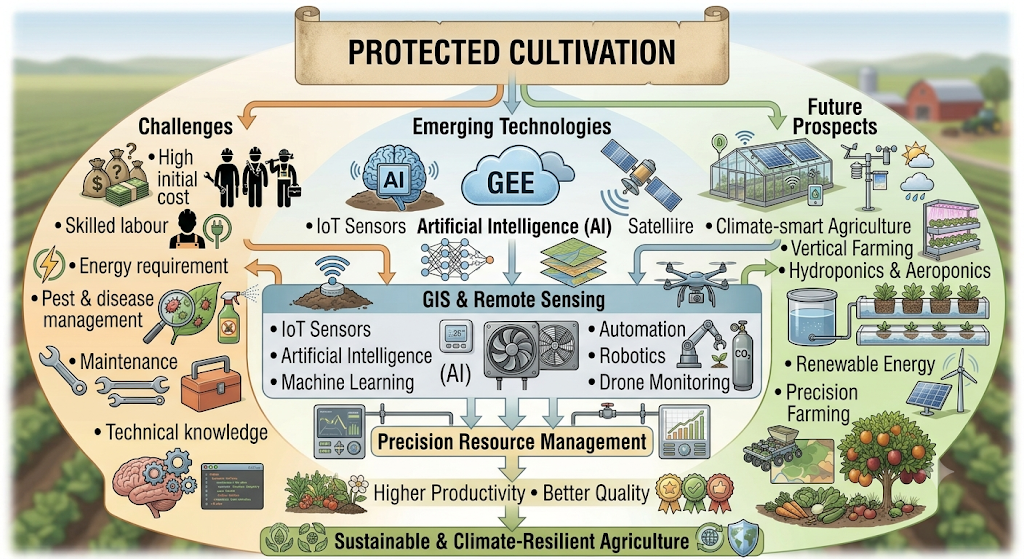
Figure. Challenges, Emerging Technologies, and Future Prospects of Protected Cultivation
Although protected structures reduce pest incidence, certain pests and diseases may become more severe under enclosed conditions. High humidity can promote fungal diseases such as powdery mildew and gray mold, while insects like whiteflies, thrips, aphids, and mites may multiply rapidly if not properly managed. Therefore, Integrated Pest Management (IPM), biological control agents, insect-proof nets, sticky traps, and regular monitoring are essential components of protected cultivation. Recent developments in digital agriculture have significantly improved the efficiency of protected cultivation systems. The Internet of Things (IoT) enables continuous monitoring of environmental parameters including temperature, humidity, carbon dioxide concentration, light intensity, soil moisture, nutrient levels, and electrical conductivity through wireless sensors. These real-time data support automated decision-making and improve crop management precision. Artificial Intelligence (AI) and Machine Learning (ML) are increasingly being integrated into greenhouse management systems. AI algorithms analyze environmental and crop data to optimize irrigation scheduling, fertigation, climate regulation, disease prediction, and harvest planning. Predictive analytics assist growers in identifying potential production problems before they affect crop performance. Automated climate-control systems further improve energy efficiency while maintaining optimum growing conditions. Robotics and automation are transforming protected cultivation by reducing labor requirements and improving operational efficiency. Automated seeding, transplanting, irrigation, harvesting, pruning, spraying, and grading systems increase productivity while ensuring consistent crop management. Drone technology and machine vision systems facilitate disease detection, crop monitoring, and growth assessment within large protected cultivation facilities.
Future protected cultivation systems are expected to increasingly adopt hydroponics, aeroponics, aquaponics, and vertical farming technologies. These soilless cultivation systems maximize productivity while minimizing water consumption, nutrient losses, and land requirements. Integration with renewable energy sources such as solar-powered greenhouse systems will reduce operational costs and improve environmental sustainability.
The future of protected cultivation is closely associated with climate-smart agriculture and precision horticulture. Geographic Information Systems (GIS), Remote Sensing (RS), satellite imagery, cloud-based decision-support platforms, and digital farm management systems will enable site-specific planning, efficient resource allocation, and continuous crop monitoring. These innovations will improve productivity while minimizing environmental impacts.
Government support through subsidies, affordable financing, research and development, quality planting material, extension services, and farmer training programs will remain essential for expanding protected cultivation. Public-private partnerships and technology transfer initiatives can further accelerate the adoption of modern protected cultivation technologies.
Overall, despite existing financial and technical challenges, protected cultivation has tremendous potential to transform vegetable production. The integration of smart technologies, automation, renewable energy, and precision farming will strengthen climate resilience, improve resource-use efficiency, enhance vegetable quality, and ensure sustainable horticultural development in the coming decades.
Conclusion#
Protected cultivation has emerged as one of the most effective technological innovations for enhancing vegetable production, improving product quality, and ensuring sustainable use of natural resources. As agriculture faces increasing challenges from climate change, water scarcity, declining land availability, and rising consumer demand for high-quality vegetables, protected cultivation provides a practical solution by creating a controlled environment that supports optimal crop growth throughout the year. Technologies such as greenhouses, polyhouses, shade-net houses, insect-proof net houses, low tunnels, and soilless cultivation systems have significantly transformed modern vegetable farming by increasing productivity while minimizing environmental risks.
The discussion presented in this paper demonstrates that protected cultivation positively influences every stage of vegetable production. By regulating temperature, humidity, light intensity, carbon dioxide concentration, irrigation, and nutrient supply, these systems promote vigorous vegetative growth, improved root development, enhanced flowering, higher fruit set, and increased crop yield. Vegetables grown under protected structures generally exhibit superior size, color, uniformity, nutritional quality, and shelf life compared to those produced under open-field conditions. Improved quality not only satisfies consumer expectations but also enhances market competitiveness and export potential.
Protected cultivation also contributes substantially to resource-use efficiency. The integration of drip irrigation and fertigation ensures precise application of water and nutrients, reducing losses through evaporation, runoff, and leaching. Hydroponics, aeroponics, and substrate culture further improve water and fertilizer-use efficiency while enabling cultivation in areas with poor or unsuitable soils. Controlled environments reduce pest and disease incidence, thereby minimizing pesticide use and promoting safer, healthier vegetables with lower chemical residues. These benefits support environmentally sustainable agricultural practices and reduce pressure on natural resources.
An important contribution of protected cultivation is its role in climate-smart agriculture. Protected structures shield crops from extreme weather events such as heat waves, frost, heavy rainfall, hailstorms, and strong winds, thereby reducing crop losses and stabilizing production. The ability to produce vegetables throughout the year ensures continuous market supply, improves farmer income, and strengthens food and nutritional security. Off-season vegetable production further increases profitability by allowing growers to capture premium market prices.
Recent advancements in digital agriculture have further expanded the capabilities of protected cultivation. Internet of Things (IoT)-based sensors, Artificial Intelligence (AI), Machine Learning (ML), Geographic Information Systems (GIS), Remote Sensing (RS), robotics, automation, and drone technologies enable real-time monitoring of environmental conditions, precise irrigation scheduling, automated climate control, disease prediction, and data-driven crop management. These innovations improve operational efficiency, reduce labor requirements, and maximize productivity while conserving resources.
Despite these advantages, several challenges continue to restrict widespread adoption, particularly among smallholder farmers. High installation costs, maintenance expenses, energy requirements, technical complexity, and limited access to quality planting materials remain major constraints. Addressing these challenges requires supportive government policies, financial assistance, research and development, farmer training, and extension services that facilitate technology transfer and capacity building.
In conclusion, protected cultivation represents a highly efficient and sustainable production system capable of meeting the growing demand for quality vegetables under changing climatic conditions. Its integration with precision agriculture, renewable energy technologies, integrated pest management, and climate-smart farming practices offers immense potential for improving agricultural productivity while conserving natural resources. Continued technological innovation, institutional support, and farmer participation will ensure that protected cultivation becomes a cornerstone of resilient, profitable, and environmentally sustainable vegetable production systems in the future.
Works Cited#
- FAO. (2021). The State of the World's Land and Water Resources for Food and Agriculture – Systems at Breaking Point. Food and Agriculture Organization.
- FAO. (2022). The Future of Food and Agriculture: Drivers and Triggers for Transformation. Food and Agriculture Organization.
- Singh, B., & Sirohi, N. P. S. (2006). Protected Cultivation of Vegetables in India: Problems and Future Prospects. Acta Horticulturae, 710, 339–342.
- Kumar, P., & Chauhan, R. S. (2018). Protected Cultivation of Horticultural Crops. Indian Journal of Horticulture, 75(4), 567–576.
- Resh, H. M. (2022). Hydroponic Food Production (8th ed.). CRC Press.
- Jensen, M. H., & Malter, A. J. (1995). Protected Agriculture: A Global Review. World Bank Technical Paper.
- Shamshiri, R. R., et al. (2018). Advances in Greenhouse Automation and Controlled Environment Agriculture: A Review. Information Processing in Agriculture, 5(1), 1–30.
- Castilla, N. (2013). Greenhouse Technology and Management (2nd ed.). CABI.
- Savvas, D., & Gruda, N. (2018). Application of Soilless Culture Technologies in Vegetable Production. European Journal of Horticultural Science, 83(5), 280–293.
- Hochmuth, G., & Hochmuth, R. (2017). Nutrient Management in Protected Vegetable Production. University of Florida Extension.
- IPCC. (2023). Climate Change 2023: Synthesis Report. Intergovernmental Panel on Climate Change.
- UNEP. (2022). Global Environment Outlook. United Nations Environment Programme.
- World Bank. (2023). Water in Agriculture. World Bank.
- National Horticulture Board. (2023). Indian Horticulture Database. Government of India.
- ICAR-Indian Institute of Horticultural Research. (2022). Protected Cultivation Technologies for Horticultural Crops. ICAR-IIHR.
- Meena, R. S., et al. (2020). Protected Cultivation for Sustainable Horticulture. Springer.
- Gruda, N. (2005). Impact of Environmental Factors on Product Quality of Greenhouse Vegetables. Journal of Applied Botany and Food Quality, 79(3), 227–234.
- ESRI. (2023). ArcGIS Pro Documentation. Environmental Systems Research Institute.
- IFA. (2022). Fertilizer Best Management Practices. International Fertilizer Association.
- CABI. (2021). Protected Cropping and Greenhouse Production Systems. CAB International.